


Research may be a tedious process of scrolling through tabs that never appear to have an end. Research does not have to exhaust you, whether you are writing a blog, a script, a report, or simply searching for something.
This guide shows how to research a topic with practical methods, helpful tools, and time-saving steps. Every step will assist you in discovering credible information, comprehending it quickly, and transforming it into valuable information, be it an article, a YouTube script, or a more profound grasp of the topic.
Have a Purpose Before You Research Anything
Most individuals go directly to Google and scroll through some articles, hoping that the answers will be found. It is better to begin before you search.
Ask yourself:
- What do I want to learn?
- Who am I writing for?
- How deep do I need to go?
- What shall I have at the end of it: content, understanding, or a decision?
This break will assist you in not being overloaded and will keep your research on track.
Build a Rapid Knowledge Map to Define the Direction
Pre-read long articles: create a basic knowledge map. It provides a framework for your search and accelerates it.
Use this 3-step method:
Step 1 – Write down what you already know
Even a sentence or two is fine. It provides you with a benchmark and demonstrates the gaps that you should address.
Step 2 – Write down the questions you require to answer
Questions keep the focus. Examples:
- What are the fundamentals of the subject?
- What are the issues that the topic addresses?
- What do they search for about it?
Step 3 – Mark out areas requiring further research
These are the pillars of your research. Even complicated issues are easier to handle with the help of the map.
How to Research a Topic Online Without Getting Lost?
Most people begin on the Internet, and it is all right, provided you know how to work through the muddles. This is how to do internet research effectively. According to Pew, 96% of American adults are internet users, and 40% use the internet at least once a day.
Use layered searching
Do not depend on the first page you pick. Build depth in layers:
- Layer 1: Introductory (Wikipedia, summary blogs, forum FAQs)
- Layer 2: Mid-level content (expert websites, niche forums, learning sites)
- Layer 3: Deep sources (research papers, books, professional reports)
This organization does not allow superficial knowledge and gives credibility to your work.
Use search operators to improve the search
With the following commands, Google is more powerful:
- topic + pdf – locates research papers.
- site:.edu topic – reveals scholarly descriptions.
- topic + case study – provides real-life examples.
- topic + trends – displays existing changes.
These make a simple search into high-value research.
Multiple Source Types to Achieve Balanced Understanding
It is not hard to remain in one of the types of sources: blogs, videos, or papers. Switching formats assists you in viewing a subject matter entirely.
Strong categories of sources are:
- Professional interviews or podcasts.
- Long-form guides
- Industry data reports
- Real-user story forums (Reddit, Quora)
- Textbooks are used to explain in a systematic manner.
Their combination provides facts and various opinions, which are excellent when conducting a subtle study.
How to Research a Topic for Content Writing?
The writing of content requires clarity, precision, and empathy. This is the way professionals conduct their research.
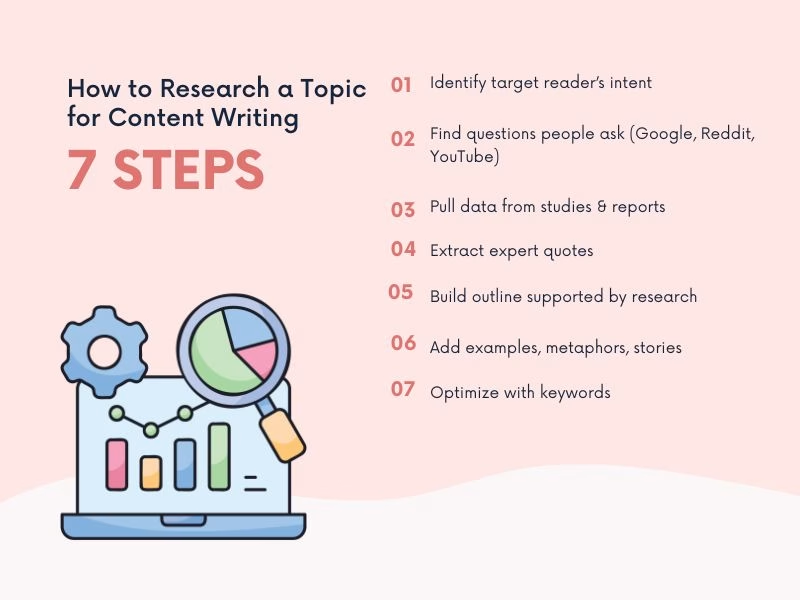
1. Identify search intent
There are three things that the readers are searching for:
- Knowledge: how to, definitions, tips.
- Comparison: advantages/disadvantages, versus analysis.
- Action: step-by-step guidance
This knowledge makes your research come true to the needs.
2. Harvest insights from SERPs
Patterns are observed in Search Engine Results Pages:
- Which subtopics repeat?
- What angles do the competitors miss?
- What people search (People Also Ask).
A brief search through SERPs can assist you in developing content that is not duplicated, but rather what is unique. One out of every four adults in 24 countries reports being online almost all the time (28%), and 40% multiple times a day.
3. Cross-verify facts
To be trusted, verify information with two or more trustworthy sources. This eliminates obsolete or erroneous data.
4. Collect examples
Examples remain in the minds of the readers. Look for:
- Real stories
- Practical applications
- User experiences
Readers relate to actual, rather than theoretical information.
How to Research a Topic for YouTube?
YouTube is visual and interaction-oriented; hence, the strategy is slightly different.
1. Analyze competing videos
Check:
- View counts
- Comment sections
- Gaps in explanations
- What questions viewers ask
People usually express what they desire in the comments.
2. Search on YouTube predictions
Start typing on your topic. The auto-suggest boxes depict what individuals are actually interested in learning. This assists in narrowing angles and subtopics.
3. Draw concepts across formats
Don’t rely only on YouTube. Add:
- Blog insights
- Podcast discussions
- Data sources
- News updates
This makes your video more than just a video of a common creator. Pew estimates that one-fifth of Americans receive news on Facebook, YouTube, Instagram, and TikTok.
How to Research a Topic You Know Nothing About?
It is easy to start with nothing, and this structure assists.
Step 1 – Start by explaining like I am a new source
Simple definitions, beginner guides, and Wikipedia create a base, and then move on to more in-depth information.
Step 2 – Identify jargon early
Every topic has its own terms. Early identification prevents confusion and accelerates learning.
Step 3 – Transfer to organized sources
Once you know the basics, use:
- Reports
- Studies
- Expert interviews
This takes you automatically to the level of an advanced.
Different Ways on How to Research a Topic for More Rounded Insights?
The information is not just online. Try these other methods.
1. Interviews
Discussion with a specialist accelerates learning. Hours of searching can be substituted for one conversation.
2. Surveys
Real experiences and opinions are collected through short surveys. Authors tend to use them as original ideas.
3. Observational research
Observing behaviors, trends, or communities provides a background that the internet might lack.
4. Books and long-form content
Books provide richness, organization, and broad thinking. They are excellent in case you want to master a subject and not skim.
Plan Your Results to Prevent Overwhelm
Research is only useful when you can utilize it. The plain system prevents the notes from becoming chaotic.
Try this structure:
- Bucket 1: Basics – definitions, main concepts.
- Bucket 2: Supporting information – statistics, research, examples.
- Bucket 3: Insights – personal observations, unusual angles.
- Bucket 4: Content ideas, headlines, story ideas, questions.
Such an organization transforms disorganized research into something useful.
Transform Research into Takeaways
Research is important only when it results in knowledge. After gathering info:
- Write a summary of each of the key ideas in a sentence.
- Relate the concepts to each other.
- Spot gaps that need more work.
- Discover gaps competitors overlook.
It is at this point that research comes in handy.
Common Mistakes When Researching a Topic
These are some of the pitfalls that retard the majority:
- Trying to read everything
- Depending on one type of source.
- Gathering data without systematizing it.
- Mixing opinions with facts
- Failure to validate claims or statistics.
Knowing these makes your process effective and precise.
Conclusion
It is not about memorizing tactics when researching. And it is about curiosity, organization, and a wish to see what others are not seeing. Regardless of whether you are writing, making a video on YouTube, or just need to clarify something, these steps build a seamless, reliable system that you can apply to anything.
FAQs
1. What is the best way to research a topic?
Begin with a purpose, collect data from various types of sources, and confirm the facts through reputable sources. Make your research surface, mid-depth, and expert to ensure that it is accurate and well-rounded.
2. How to research a topic quickly?
Create a basic knowledge map, apply specific keywords, and apply such tools as Google operators or YouTube suggestions. This avoids wasting time and concentrates on valuable information.
3. How to research a topic online effectively?
Blend general information (Wikipedia, blogs), credible expert websites, and in-depth materials such as research and reports. Combine formats to maintain accuracy and prevent superficial knowledge.
4. How to research a topic for content writing?
Determine the purpose of searching, scan search engine results, gather examples, and triangulate facts. This makes your content original, relevant, and useful to the readers.
5. How to research a topic for a YouTube video?
Competitor video analysis, comment sections, and question analysis; auto-suggested videos, trending angles, blogs, podcasts, and reports can be used to create a more comprehensive script.