

Marketing is most effective when it responds to the actual behavior of people, rather than their identity. That’s where a behavioral segmentation strategy becomes a competitive advantage. Rather than making assumptions about age or location, brands can build experiences based on actual behavior – clicks, purchases, usage patterns, and engagement cues.
This strategy not only enhances targeting. It alters the way companies think about customers, growth, and long-term value.
What Is Behavioral Segmentation?
Behavioral segmentation is a marketing strategy that classifies customers according to their behaviors, interactions, and decision-making. It is more concerned with observable behavior and not assumptions.
In its essence, behavioural segmentation in marketing provides answers to questions such as:
- How often does a customer buy?
- What features do they use?
- At what point do they fall in the funnel?
- What is their reaction to campaigns?
By knowing these signals, the brands are able to match messaging, timing, and offers with real intent.
What Is Behavioural Segmentation in Marketing (and Why It Matters)?
Demographics continue to be a primary tool of many marketers. Demographics are useful, but do not describe why a person converts or why not.
Behavioral market segmentation fills that gap by:
- Capturing real-time intent
- Increasing the accuracy of personalization.
- Reducing wasted ad spend
- Enhancing retention and loyalty.
Consider it as the distinction between knowing the job title of a person and knowing that he or she has left out a checkout page twice this week. One is static. The other is actionable.
Personalization initiatives typically increase company revenue by around 10–15%, varying by sector and execution capability, according to a McKinsey research report.
What Is Behavioral Segmentation Strategy vs Behavioral Segmentation?
The two terms are usually confused, yet they are used for different purposes.
What is a behavioral strategy?
A behavioral strategy is a more general strategy that outlines how a business would change the behavior of customers in the long run. It comprises nudges, incentives, product design, messaging, and timing.
What is behavioural segmentation?
That strategy is driven by behavioral segmentation. It segments customers into valuable groups according to behavior, and strategy execution is accurate rather than generic.
Strategy is informed by segmentation. Segmentation is triggered by strategy.
Types of Behavioural Segmentation Marketers Use
Not every behavior is equal. Successful teams are concerned with indicators of intent, value, or risk.
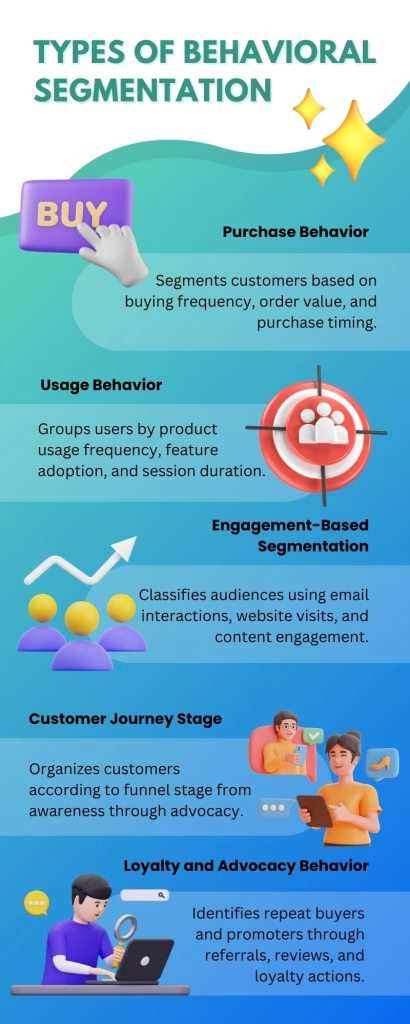
Purchase Behavior
This is one of the most widely used types of behavioural segmentation.
Common segments include:
- First-time buyers
- Repeat customers
- High vs low value spenders.
- Cart abandoners
This is important to the retail and e-commerce brands to customize promotions and retention offers. Average online shopping cart abandonment rates hover near 70.2%, representing major lost revenue opportunities for eCommerce brands worldwide, studies show.
Usage Behavior
The usage patterns indicate the experience of a product by the customers after conversion.
Examples include:
- Power users and occasional users.
- Feature adoption trends
- Frequency and duration of the session.
SaaS businesses frequently leverage this data for onboarding, upsells, and churn prevention.
Engagement-Based Segmentation
Interest is expressed–prior to a purchase occurring.
This includes:
- Email opens and clicks
- App interactions
- Content consumption
Very active users will require other messaging as compared to silent users, who might require reactivation.
Customer Journey Stage
Naturally, behavior varies as one is on one side of the funnel or another.
Segments normally coincide with:
- Awareness
- Consideration
- Retention
- Advocacy
Behavioral segmentation strategy works best when messaging matches the journey stage, not just the persona.
Loyalty and Advocacy Behavior
There are those customers who make repeat purchases. Others are also the ones who advertise the brand.
This market segment targets:
- Repeat purchase frequency
- Referral activity
- Reviews and social sharing
These users are usually the most lucrative and the simplest to mobilize using exclusivity campaigns.
Behavioral Segmentation Strategy Benefits for Businesses
Brands that are built on behavior and not assumptions always do better than their competitors. The benefits multiply as time goes by.
Increased Interchannel Relevance
Messages are received more effectively when they capture the recent behaviors rather than the general characteristics.
Improved Conversion Rates
The intent-based targeting of users minimizes friction and decision-making time.
Greater Retention and LTV
The insights of usage assist the brands to intervene before disengagement becomes churn.
More Intelligent Distribution of Resources
Marketing expenditure is not aimed at wide audiences but rather at segments that are likely to respond.
Behavioral segmentation benefits don’t come from complexity; they come from alignment.
How to Build an Effective Behavioral Segmentation Strategy?
A successful behavioral segmentation strategy doesn’t require massive datasets. It needs to be clear and consistent.
Step 1: Establishing Specific Business Objectives
Start with outcomes, not data.
Examples:
- Reduce churn
- Increase repeat purchases
- Improve feature adoption
- Boost email conversions
Goals identify the behaviors that are of actual importance. Segmented email campaigns produce roughly 14–30% higher open rates compared to non-segmented campaigns across multiple studies, reported by industry benchmarks.
Step 2: Determine High-Impact Behavioral Signals
All clicks do not warrant a segment.
Pay attention to those behaviors that show:
- Purchase intent
- Product adoption
- Drop-off risk
- Long-term value
Quality beats quantity here.
Step 3: Gather and Integrate Behavioral Data
The data are already available in most businesses; it is just a matter of connecting them.
Common sources include:
- Website analytics
- CRM systems
- Email platforms
- Product usage tools
By integrating these sources, one will have a single behavioral perspective of the customer.
Step 4: Develop Behavioral Segments to Act upon
Segments must be action-oriented.
Good segments are:
- Clearly defined
- Large enough to matter
- Activation is easy across channels.
A segment that cannot be targeted by a campaign is useless.
Step 5: Test, Learn, and Refine
Behavior changes over time. Segments should too.
Segmented campaigns through A/B testing are useful:
- Validate assumptions
- Improve messaging
- Optimize timing and offers
Performance gains occur at the point of iteration.
Examples of Behavioral Segmentation in Action
The value is made real in real-life situations.
eCommerce Example
A fashion brand online divides the users who:
- Viewed a product three times
- Added to cart and did not buy.
They send a customized email containing social proof rather than a discount. There is an increase in conversion rates without the loss of margin. Behaviorally segmented email campaigns show 42.5% open rates vs. 28.7% for non-segmented campaigns, improving engagement significantly.
SaaS Example
One of the productivity tools divides users who:
- Registered but not utilized a core feature in 7 days.
They are given in-app instructions and a brief tutorial email. Activation is enhanced, churn is minimized.
Content Marketing Example
A B2B blog divides the readers according to:
- Topics consumed
- Frequency of visits
Repeat visitors receive more in-depth and solution-oriented content, and first-time visitors receive educational materials.
These examples of behavioral segmentation show how small signals create an outsized impact.
Behavioral Developmental Strategies: Customer Behavior Growing
The behavioral developmental strategies are concerned with the way behavior changes with time. Brands expect change instead of treating segments as fixed. Behaviorally segmented emails yield 7.8% conversion rates vs. 3.4%, highlighting stronger purchase outcomes.
This includes:
- Migrating users to adoption.
- Getting one-time buyers to make a repeat purchase.
- Converting satisfied customers to fans.
Growth can be predicted when behavioral maturity is reflected in segmentation.
Mistakes that destroy Behavioral Segmentation
These are the mistakes even powerful teams commit.
- Unactivated over-segmentation.
- Considering behavior as fixed rather than dynamic.
- Disregard of the context of actions.
- Concentrating on vanity measures rather than intent signals.
A behavioral segmentation strategy should simplify decisions, not complicate them.
Success of Behavioral Segmentation Strategy Measurement
Business goals should always be linked to performance.
Key metrics often include:
- Conversion rate lift
- Engagement improvement
- Retention and churn minimization.
- Customer lifetime value
When segmented and non-segmented campaigns are compared, it is evident that there is an actual impact.
Future of Behavioral Segmentation in Marketing
The development of AI and automation is transforming the behavioral usage of brands.
Emerging trends include:
- Anticipatory behavior modeling.
- Real-time personalization
- Tracking of cross-channel behavior.
- Data strategies that are privacy-first.
The winning brands will not view behavior as a dead label. AI-driven personalization can boost marketing ROI by 10–30% and reduce acquisition costs up to 50% in their analysis.
Conclusion
A strong behavioral segmentation strategy doesn’t rely on guesswork. It hearkens to the customers by listening to their actions and acting accordingly.
Marketing is less intrusive and more helpful when the businesses match messaging, timing, and experience with behavior. It is where sustainable growth starts.
In case your campaigns continue to use mass audiences or old-fashioned personas, begin with small campaigns. Create one important behavior, develop one valuable segment, and engage it in one channel. The momentum is gained sooner than anticipated.
FAQs
1. What is a behavioral segmentation strategy?
It is a marketing strategy that clusters customers based on actions, usage, and engagement to provide more relevant and personalized experiences.
2. What is behavioural segmentation in marketing?
It divides audiences according to actual customer actions such as purchases, interactions, and stage of the journey rather than demographics alone.
3. What are the types of behavioural segmentation?
Typical ones are purchase behavior, usage behavior, level of engagement, customer journey stage, and loyalty-based segmentation.
4. What are the advantages of behavioral segmentation?
It enhances personalization, boosts conversions and retention, and assists companies in targeting more intentional customers.
5. What are examples of behavioral segmentation?
They can be cart abandoner targeting, power-user onboarding campaigns, inactive user reactivation emails, and rewards programs based on loyalty.