

Adobe is not merely a software company; it is a marketing masterpiece. From Creative Cloud to Experience Cloud, Adobe products have become a household name among creators and entrepreneurs. But what truly sets Adobe apart isn’t just innovation in design tools — it’s the Adobe marketing strategy that fuels customer engagement, adoption, and loyalty.
This Adobe case study explores how the company leverages marketing mix modeling, automation, and creative campaigns to stay ahead of competitors. Marketing mix modeling attributes percentage contributions to sales, enabling optimized budgets and channel ROI decisions, per Google’s MMM guide.
As a marketer or business enthusiast, the knowledge of how Adobe does things can provide you with practical information about contemporary marketing strategies.
Adobe Company Overview
Adobe was established in 1982 as a small software company, but it has developed to become a worldwide leader in creative and digital experience solutions. McKinsey reports 80% of AI high performers prioritize efficiency, with many reporting consistent measurable gains in growth, productivity, and innovation.
Its core offerings include:
- Creative Cloud: Photoshop, Illustrator, Premiere Pro, and other creative applications.
- Document Cloud: Adobe Sign, document management solutions, and Acrobat.
- Experience Cloud: Experience management tools based on AI and analytics.
Adobe has a diverse client base of individual creatives and students, as well as large business organizations and agencies. Its strong brand presence is supported by a well-crafted Adobe marketing strategy that ensures products reach the right audience effectively.
Marketing Goals: Spurring Development and Participation
The marketing strategy of Adobe is not arbitrary. All campaigns and tools have definite purposes that correspond to business development. Key marketing goals include:
- Brand Awareness: Position Adobe as the provider of creative and digital experiences.
- Customer Acquisition: Acquire new users for Creative Cloud subscriptions and enterprise solutions.
- Customer Retention: Maintain the interest of the users by providing updates, tutorials, and loyalty programs.
- Product Adoption: Promote the use of new features, integrations, and AI-powered tools.
It is also important to measure success. Adobe uses Adobe marketing tools and analytics to track engagement, conversion rates, and ROI. This will make sure that all marketing activities are aimed at general development.
Target Audience Analysis
The marketing strategy of Adobe is based on understanding the audience. The company divides its market into definite groups:
- Single Creatives: Freelancers, designers, photographers, and videographers.
- Enterprises: Companies seeking document management and marketing services.
- Schools and Universities: Universities and schools use Adobe products to teach creativity.
- Developers & Agencies: Experts who are using Adobe products in client projects.
To every segment, Adobe determines pain points and crafts messages that resonate. As an illustration, Creative Cloud campaigns focus on flexibility and innovation to individual creators, whereas Experience Cloud campaigns focus on quantifiable ROI to businesses.
Adobe also applies Adobe marketing mix modeling to predict which channels and campaigns will perform best for each audience, optimizing spend and impact.
Adobe Marketing Strategy: How Creativity Meets Data
The marketing strategy of Adobe is a combination of creativity, technology, and customer-focused thinking. Each strategy will be aimed at enhancing brand value and delivering quantifiable outcomes.
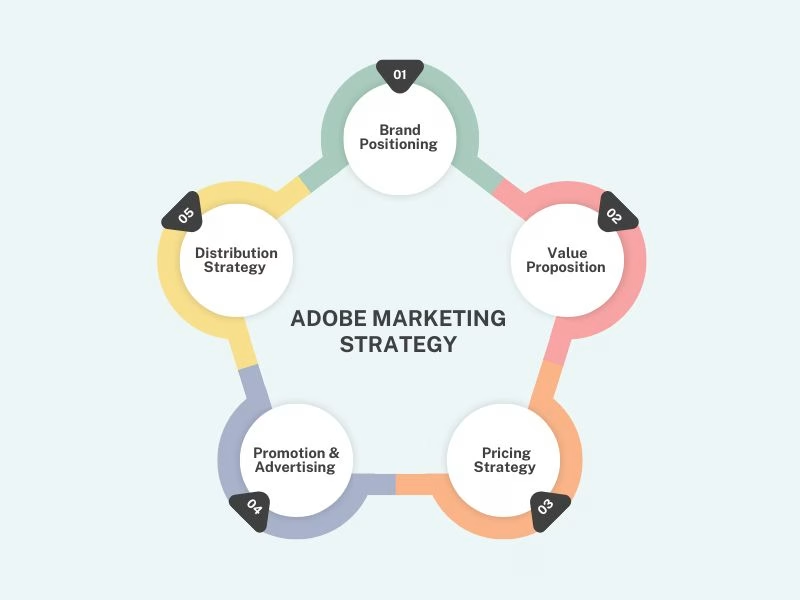
Here’s a closer look:
Brand Positioning
Adobe markets itself as a high-end, innovative software company to creative professionals and businesses. Its marketing emphasizes:
- Creativity and inspiration
- Fluid cross-tool integration.
- Artificial intelligence-driven innovation at Adobe Sensei.
This excellent positioning enables Adobe to dictate loyalty and charge high prices.
Value Proposition
Adobe has a subscription-based business model, Creative Cloud, which changes conventional software acquisition into a dynamic, continuous relationship. Key benefits include:
- Constant improvements and innovations.
- Team collaboration in the cloud.
- Availability of the newest tools without huge initial expenditures.
This is the best strategy that fits the marketing strategy of Adobe, which focuses on convenience, innovation, and productivity.
Pricing Strategy
Adobe balances accessibility and premium positioning. Whereas individual plans are used by freelancers and students, enterprise subscriptions provide more integration and analytics. This price ladder will make Adobe attractive to a large customer base without eroding brand value.
Promotion & Advertising
The promotional strategies of Adobe are a combination of digital, content, and experience marketing:
- Digital Marketing: Social media campaigns, content-based search engine optimization, and targeted advertisements.
- Content Marketing: Webinars, creative challenges, tutorials, and blogs encourage interaction.
- Community & Influencer Marketing: Adobe Creative Cloud community builds loyalty and word of mouth.
- Events & Sponsorships: Adobe MAX conferences are a place of innovation and user education.
These campaigns show that the company is skilled in creativity and data-driven marketing, and every interaction is significant.
Distribution Strategy
Adobe makes sure that its products are available worldwide:
- Direct sales through the Adobe site.
- Bigger reach through reseller and partner networks.
- Convenient access in the form of app marketplaces.
All channels are connected to marketing automation, analytics, and customer insights to create seamless user experiences that are seamless.
Adobe Marketing Campaigns: Creativity in Action
The marketing campaigns of Adobe can be described as evidence of its focus on innovation, inclusivity, and involvement in the community.
A 2023 design survey found over 85% of full-time professional designers regularly use at least one Adobe product report. The following are some of the most notable campaigns that have produced great effects:
#CreateWithAdobe
The campaign is called #CreateWithAdobe, and it is a worldwide campaign aimed at inspiring people to express their creativity with the help of Adobe tools. Removing the emphasis on a single creator and his/her projects, Adobe creates a feeling of community and inspiration.
This campaign not only highlights the versatility of the Adobe products but also highlights the commitment of the brand to help in enabling creative expression on different platforms.
“Dream Bigger”
Dream Bigger is an effective campaign that glorifies women in sports and their successes. Adobe enhances narratives of success and perseverance through collaborations with such organizations as the National Women’s Soccer League (NWSL).
This campaign is in line with the Adobe values of inclusivity and empowerment and appeals to audiences that appreciate diversity and perseverance.
“Love the Journey”
Adobe partnered with artist Little Simz to create the campaign “Love the Journey,” exploring the creative process and the stories behind the art.
Adobe emphasizes the value of creativity and self-expression by concentrating on the journey and not only on the destination. This campaign highlights how Adobe has been able to support artists and their stories, building a stronger bond with the audience.
Fantastic Voyage to Photoshop
To promote the possibilities of Photoshop, Adobe launched the Fantastic Voyage campaign, where the viewers are shown a surreal tour of the features of the software. Adobe combines narration and product presentation to show how powerful and versatile Photoshop can be.
This campaign targets both experienced professionals and the ones who aspire to become professionals, emphasizing the limitless opportunities of the Adobe ecosystem.
LinkedIn Sponsored Content
Adobe realized the professional potential of LinkedIn and used sponsored content to target marketers and business professionals. Adobe became a thought leader in the digital marketing arena by posting pertinent updates and information.
This is a strategic application of LinkedIn that enables Adobe to reach a specific group of people to promote brand awareness, as well as build professional relationships.
Adobe Marketing Automation & Technology: Powering Smart Campaigns
Adobe is not just a company that uses creativity as the core Adobe marketing strategy, but technology and data play a central role in its marketing approach. Adobe is efficient, personalized, and measurable by using automation, analytics, and AI to make sure that campaigns are efficient.
Companies excelling at personalization generate 40% more revenue, according to McKinsey; evidence supports investment in personalized marketing across sectors worldwide.
Adobe Marketing Strategy Tools
Adobe offers a set of marketing software that assists their internal staff, as well as their customers in streamlining campaigns:
- Adobe Experience Cloud: Unites customer data, content, and analytics.
- Adobe Analytics: Monitors user behavior, campaign performance, and ROI.
- Adobe Campaign: Provides cross-channel marketing that is automated.
- Adobe Sensei: Artificial intelligence-based insights into personalization and predictive analytics.
These tools make Adobe customize messages, automate workflows, and target more effectively, making every marketing dollar count.
Marketing Automation in Action
Automation will enable Adobe marketing strategy to provide the appropriate content at the appropriate time:
- Individualized emails that would take users through the new features.
- Websites that are dynamic depending on user behavior.
- Automated lead nurturing for enterprise clients using Adobe marketing solutions.
Email personalization can raise open rates by 26% and click-through rates by 97%, per Adobe’s marketing research and benchmarks, globally measured.
Adobe uses automation and creative campaigns such as #CreateWithAdobe to maximize engagement and conversion without sacrificing personal touch.
Data-Driven Decision Making
Adobe leverages Adobe marketing mix modeling to assess the effectiveness of campaigns across channels. This helps in:
- Budgeting for good campaigns.
- Anticipating customer behavior and the adoption of products.
- Real-time campaign optimization to improve ROI.
This creativity and analytics will make the marketing strategy of Adobe creative and measurable.
Difficulties in Adobe Marketing Strategy: Competitive Landscape.
Even giants in industry such as Adobe face challenges. These challenges are understood to realize how strategic their marketing approach is.
Fierce Competition
Adobe has stiff market rivals in the creative and business software market, including:
- Design tools for Canva and Figma.
- Nitro and DocuSign in document management.
- Enterprise experiences solutions for Salesforce and Oracle.
To remain competitive, Adobe focuses on innovation, community, and premium positioning in every campaign.
Subscription Fatigue
Moving users to subscription-based models instead of one-time purchases is not always welcome. Adobe responds to this by:
- Value communication in Creative Cloud and Experience Cloud.
- Emphasizing constant updates and teamwork.
- The educational material shows real-life advantages.
Global Market Variations
Regions have different adoption rates, regulations, and cultural preferences. Adobe manages to overcome these challenges by:
- Localized language and cultural relevance campaigns.
- Local alliances and distributors.
- Targeted content using Adobe marketing automation
Customer Retention and Engagement
SaaS models are based on retaining users. Adobe combats churn with:
- Regular changes and innovations.
- Community-based campaigns such as #CreateWithAdobe.
- Personalized content and tutorials powered by Adobe marketing solutions
Through confronting these challenges, Adobe has a strong marketing strategy, which balances creativity, technology, and customer needs.
Results & Impact: How Adobe Marketing Strategy Drives Success?
Adobe not only engages in creative marketing activities, but it also provides tangible outcomes. Adobe has attained quantifiable expansion on various fronts by integrating campaigns, automation, and analytics.
Growth in Revenue and Market Share
- The subscription business model at Adobe has led to a steady increase in revenues, and Creative Cloud and Experience Cloud are at the forefront.
- Targeted campaigns and Adobe marketing mix modeling ensure that marketing spend drives high ROI.
Customer Retention and Acquisition
- Brand loyalty and community engagement are developed through campaigns such as #CreateWithAdobe and Adobe MAX.
- Individualized experiences and automated nurturing lower churn, retaining subscribers and making them happy.
Brand Awareness and Leadership
- The visibility of such campaigns as Dream Bigger and Love the Journey makes Adobe a creative and socially responsible leader.
- The brand has high recognition both in B2C and B2B markets, supported by thought leadership content and industry relationships.
Innovation Recognition
- Adobe has been recognized as an excellent marketer with the use of AI, personalization, and automation.
- The integration of Adobe marketing tools and analytics showcases a forward-thinking approach that competitors often emulate.
Conclusion
This Adobe case study highlights how Adobe’s marketing strategy blends creativity, technology, and customer insight to maintain its industry leadership. From globally recognized campaigns to intelligent use of Adobe marketing automation and analytics, Adobe sets a standard for modern marketing.
Adobe proves that strategic, data-driven, and community-oriented marketing can be powerful, whether you are a marketer who needs to be inspired or a business that wants to streamline your campaigns.
Through its regular innovation, good understanding of the audience, and intelligent application of technology, Adobe will remain at the top–it is true that marketing is an art and a science.
FAQs
1. What is the core focus of Adobe’s marketing strategy?
Adobe’s marketing strategy revolves around combining creativity with data-driven insights. The company uses AI, automation, and customer analytics to personalize experiences while running campaigns that inspire and educate its creative community.
2. Why is the Adobe case study important for marketers?
This Adobe case study highlights how a global brand uses storytelling, community-building, and marketing automation to grow engagement and revenue. It offers practical lessons for businesses wanting to modernize their digital marketing approach.
3. What is Adobe’s most popular marketing campaign?
Some standout campaigns include #CreateWithAdobe, Dream Bigger, Love the Journey, and Adobe MAX promotions. These campaigns elevate creators, celebrate culture, and showcase the power of Adobe tools in real-world storytelling.
4. How does Adobe use marketing mix modeling?
Adobe marketing mix modeling helps the company evaluate which channels – social, email, video, events, search – drive the highest ROI. This allows Adobe to allocate budget effectively and optimize campaigns based on real performance data.
5. How does Adobe automate its marketing?
Adobe uses Adobe Campaign and Sensei AI to automate emails, customer journeys, product recommendations, content personalization, and triggered campaigns. This ensures timely, relevant messaging without manual effort.