

Employers do not use the terms CV and resume interchangeably as many job applicants do. Understanding the difference between CV and resume can decide whether your application lands an interview or gets overlooked.
The two documents have different purposes, emphasize different kinds of achievements, and even have different formats. After understanding their differences, you will develop better applications that will meet the expectations of the recruiters in each case.
We are going to unravel the difference between CV and resume with the help of easy examples, familiar situations, and practical hints.
What Is a Resume?
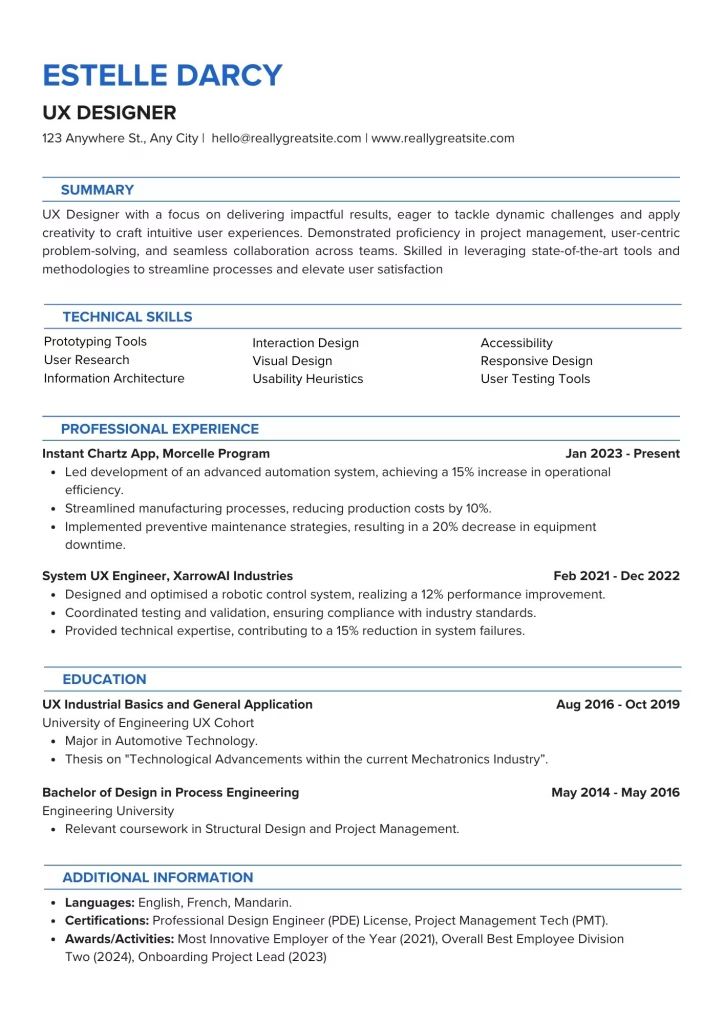
A resume is a brief, focused overview of your skills, employment background, and accomplishments.
It is designed to fit a particular job description and not all your professional history. Imagine it as your own highlight reel – only the most appropriate, best things will be included.
A Resume Typically Includes:
- Contact details
- A short profile or summary
- Essential job-specific skills
- Work experience
- Education
- Relevant certifications or achievements in the job
Most resumes remain on one page. Two pages can be good when you are highly experienced, but the golden rule is brevity.
Example Scenario:
When you are seeking a digital marketing job, you need to highlight campaigns, analytics tools, and results on your resume, not your irrelevant part-time jobs ten years ago.
What Is a CV?
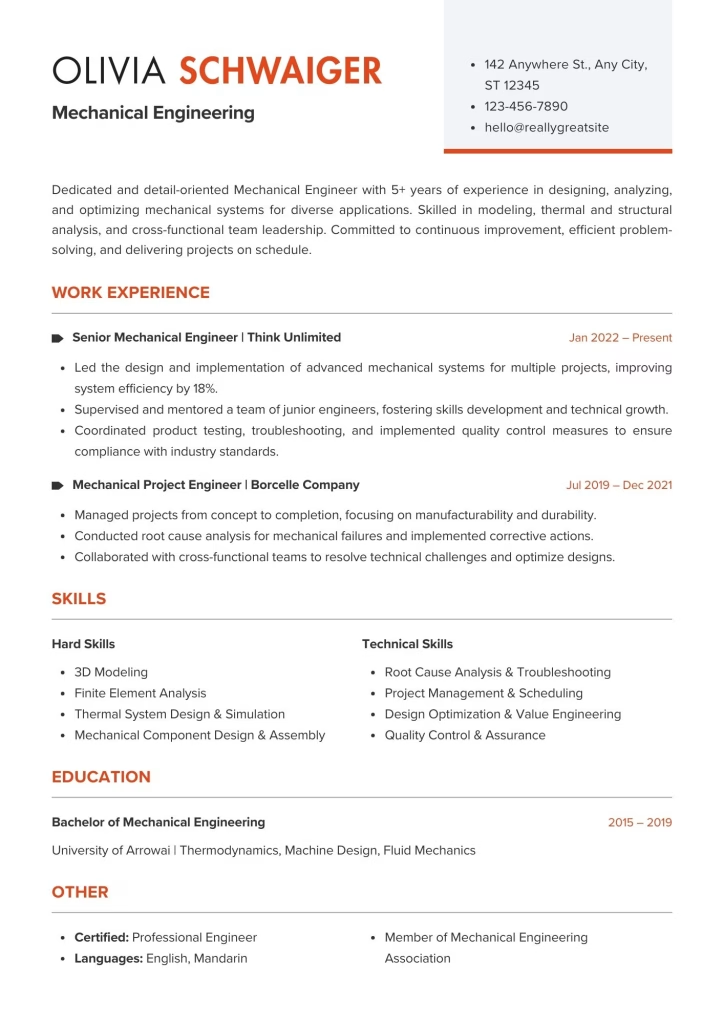
A CV (Curriculum Vitae) is a detailed, elaborate document that provides a summary of your whole academic and professional life. It is not like a resume in that it only increases with more experience.
It’s commonly used for:
- Academic positions
- Research roles
- Medical fields
- Fellowships and grants
- Postgraduate admissions
A CV Usually Includes:
- Contact details
- Full academic background
- Research experience
- Publications
- Teaching experience
- Awards
- Grants and fellowships
- Meetings and talks
- Memberships and certifications
CVs can be as many as several pages, particularly in the case of an experienced scholar or researcher.
Example Scenario:
A PhD student who is seeking a research fellowship has to enumerate all publications, papers, presentations, and other academic accomplishments – information that a resume would never contain.
The Core Difference Between CV and Resume
To understand the difference between CV and resume, it helps to compare the two side-by-side. Although they serve the same purpose, that is, to get you noticed, their structure and purpose vary.
Length
- Resume: 1-2 pages
- CV: No page limit
Focus
- Resume: Skills + work experience
- CV: Academic and professional history complete
Use Cases
- Resume: Corporate, business, tech, creative, HR, sales, and almost any job in the industry
- CV: Academia, research, medicine, scientific positions, and overseas opportunities
Customization
- Resume: Tailored for each job
- CV: Updated version of the same document
Format
- Resume: Terse, achievement-oriented
- CV: Detailed, chronological
Tone
- Resume: Results-oriented
- CV: Academic-oriented
Content Priority
- Resume: Influence, accomplishments, metrics
- CV: Qualifications, contributions, academic impact
Geographic Differences
- Resume: U.S. and Canada Standard
- CV: CV can be translated as resume, which can be quite confusing in Europe
Purpose of Evaluation
- Resume: Can you fit into this job at this moment?
- CV: What has been your academic and professional experience?
Reader Expectation
- Resume: Quick scan in 6-10 seconds
- CV: Critical analysis of qualifications and experience
These ten points capture the commonly searched “10 differences between CV and resume” query while keeping the flow natural.
Why the Difference Between CV and Resume Confuses People?
Some of the confusion is due to geography. In the United States, job applications are referred to as a resume. In places such as India, the United Kingdom, South Africa, or the Middle East, individuals tend to refer to a resume as a CV, yet they mean resume.
Another reason: there are applicants who make a hybrid document and post it everywhere. This may lead to a discrepancy between what the employer anticipates and what is on his desk.
The employer recruiting a tech does not desire a seven-page document. A small one-page resume will not impress a committee that is hiring a lecturer.
Which is better? CV or Resume?
Here’s a quick decision guide:
Use a Resume When:
- You are seeking corporate or industry employment
- The job description focuses on skills and experience
- You must customize your application to each job
Use a CV When:
- You are a scholar or researcher applicant
- You should provide publications, conferences, or academic accomplishments
- The position will demand a description of your qualifications
In case of doubt, job listings can provide hints. Such words as curriculum vitae, research experience, publications, or teaching record led to a CV.
How to Write a Good Resume?
Your resume must be crisp, modern, and relevant to memorable.
Tips to Elevate Your Resume:
- Begin with a concise, 2-3 sentence summary
- Bullet points should be achievement-oriented rather than duty-oriented
- Add measures: “Increased sales by 32 percent” rather than Managed sales team
- Adapt skills to individual job advertisements
- Make it simple and scannable
A good resume brings out the best in you as the best candidate at this moment.
How to Write a Good CV?
A CV must narrate your academic development and work experience.
Tips to Strengthen Your CV:
- Keep parts in chronological order
- Include DOIs or links to published research
- Write down conferences and dates with the titles of the presentation
- Showcase current initiatives or partnerships
- Keep it updated as your studies go on
A CV should be skimmable and complete.
Difference Between CV and Resume – Quick Comparison Table
| Feature | Resume | CV |
| Purpose | Job applications | Academic/research jobs |
| Length | 1-2 pages | No limit |
| Content | Relevant skills and experience | Full academic/professional record |
| Personalization | Job-specific | Same document, revised |
| Specialization | Achievement and outcomes | Qualification and contributions |
| Format | Flexible | Detailed and structured |
| Best fit | Corporate positions | Academic disciplines |
| Tone | Professional and concise | Formal and academic |
FAQs
1. What is a resume?
A resume is a concise and focused document that shows the relevant skills and work experience for a particular job.
2. What is a CV?
A CV is a more extensive and in-depth document that presents all your academic and professional background.
3. Is it possible to send a resume rather than a CV?
Only when the job description requires one. Academic recruiters require a CV.
4. What is the main difference between CV and resume?
A resume is brief and job-oriented, whereas a CV is detailed and is applied in academic or research-based applications.
5. When should I use a CV?
Academic, research, medical, scientific, and other positions, or when the application form is seeking extensive educational and scholarly data.